This week’s Our Dogs announces the launch of a major new evaluation of the Innate Health Assessment.
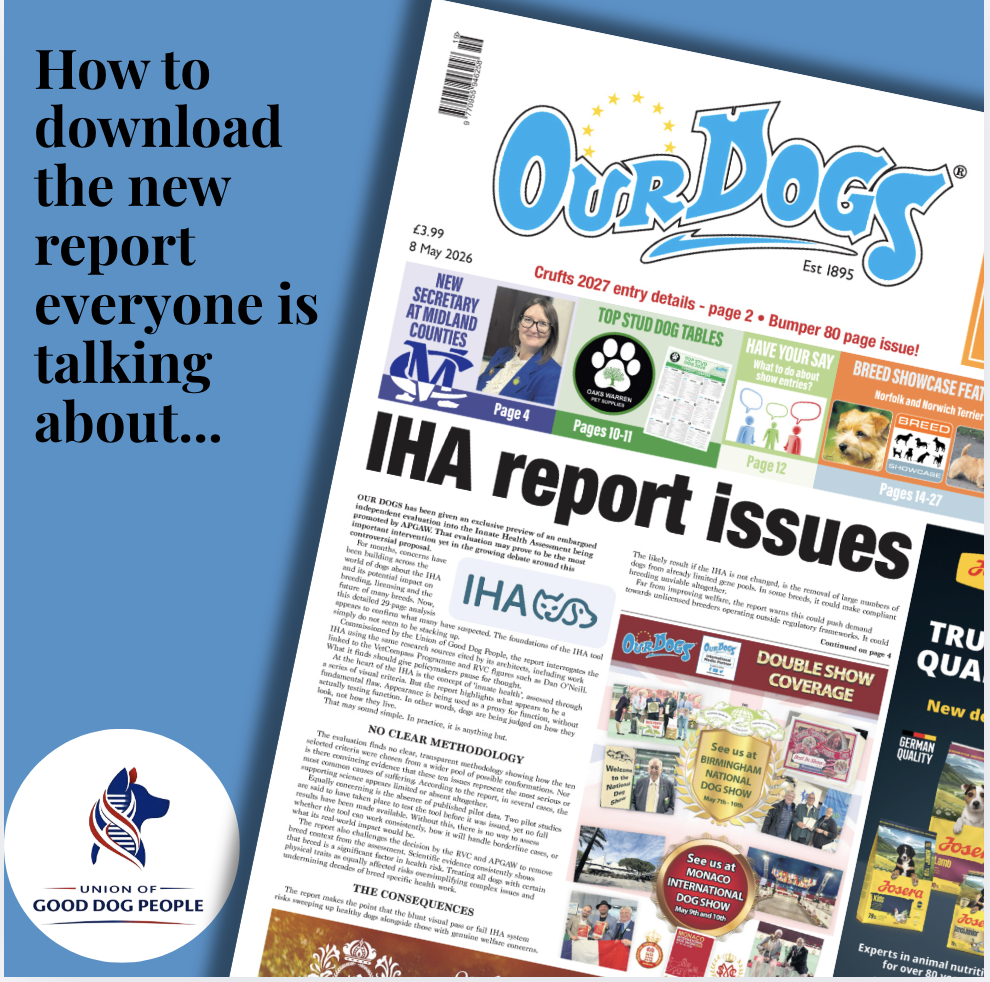
Today, the full report is published.
It raises serious questions about whether the IHA is evidence based, proportionate, or fit for purpose.
A Detailed, Evidence Based Evaluation
This report has been developed on behalf of the Union of Good Dog People.
It examines:
- The concept of innate health
- The evidence underpinning the IHA
- The selection of the criteria
- The methodology and testing
- The likely real world impact on dogs and breeds
This is not commentary.
It is a structured evaluation of the evidence.
The Five Questions Still Not Answered
For months now, the Union of Good Dog People has been asking simple, reasonable questions about the Innate Health Assessment (IHA).
Questions that go to the heart of whether this tool is fair.
Whether it is evidence-based.
And whether it will actually improve dog welfare, or risk doing harm.
We asked them directly.
We asked them clearly.
We are still waiting.
These are not technical quibbles.
They are fundamental.
1. How were the traits chosen?
What was the methodology used to identify so-called “extreme conformations” in the first place?
And how were the final ten criteria selected from the original pool?
Without transparency here, we are being asked to trust conclusions without seeing the workings.
2. Where are the pilot results?
We have asked for the full pilot reports.
Not summaries. Not headlines.
The actual data, methods and conclusions.
If this tool is to shape breeding decisions and potentially influence licensing, the evidence must be open to scrutiny.
3. How were pass and fail thresholds set?
On what basis were the cut-offs decided for key areas such as:
- Brachycephaly
- Tail length
- Ground clearance
These are not black-and-white traits.
So why is the assessment?
4. What evidence supports visual assessment as a welfare tool?
At the core of the IHA is a simple idea:
that welfare risk can be judged visually.
We are asking for the evidence that supports that claim.
Because if the tool cannot reliably distinguish between healthy dogs and those at risk, it risks failing both.
5. What happens in the real world?
What is the plan for:
- Borderline cases
- Appeals
- Inconsistent assessments
- Enforcement in licensing
How will this actually work outside of theory?
Because real dogs, in real homes, deserve better than a blunt pass or fail.
Why this matters
We agree that action is needed where dogs are suffering.
But action must be:
- Proportionate
- Evidence-based
- Targeted where it will make a real difference
The Union’s position
We are asking for transparency.
We are asking for evidence.
We are asking for a seat at the table.
Because the people who live with, breed, and care for these dogs every day must be part of the solution.
Until these questions are answered, confidence in the IHA will remain fragile.
And rightly so.
“The IHA uses visual assessment to assume functionality, without actually testing capability.”
Why It Was Written
We met the team behind the Innate Health Assessment (IHA) in January and, during this meeting, we asked a number of questions about its concepts, development process and methodology.
Although we requested additional information relating to the design and development of the tool, we are surprised and disappointed that this still hasn’t been provided.
While we strongly agree that measures are needed to address serious welfare concerns associated with some “extreme conformations”, we felt the inclusion of some of the features was not consistent with the IHA’s claims that they caused a high risk of suffering. We also feared the blunt pass or fail outcome of the test may disproportionately impact breeds where there is little or no associated health risk and would not be the most effective way to improve the health of breeds where there are significant issues.
As representatives of the ethical dog breeding community, it is important that our position on the IHA is based on fact and evidence. We recognise there are uncomfortable truths to be faced for some breeds and that difficult decisions may need to be made for the sake of dog welfare. However, we also understand our members’ depth of knowledge and passion. We accept that changes are necessary, but we also believe it is essential that any action plan is proportional to the severity of the risk, has clearly defined outcomes, is evidence based and is targeted to ensure maximum benefit and minimal harm. We also maintain that it is essential that the ethical breeding community is involved with, and as far as possible endorses, the development of proposals which will impact them and the breeds they love.
We have therefore undertaken a thorough evaluation of the IHA against the available evidence. Our intention in doing this was to assess, as impartially as possible, the design and development of the tool and its likely effectiveness.
We have identified a number of significant concerns with the IHA in its current format, based on the same evidence that has been cited to support it. There also remain substantive unanswered questions regarding the underpinning concept of innate health, the process of developing and testing the IHA, its practical application and enforcement.
We feel our report shows there is more than sufficient justification to initiate a full review of the IHA and to reconsider its deployment. We recognise that there is considerable merit in the idea of introducing a simple preliminary visual assessment for breeding dogs, but that it should act as an indicator for specific actions such as DNA tests, rather than fail dogs completely based solely on appearance.
We presented our report and alternative proposal to Dr O’Neill in advance of publishing it. We are encouraged that we have been assured our findings will be considered in the ongoing evolution of the IHA, alongside feedback raised by other organisations and individuals.
However, we are disappointed that our concerns have not been acknowledged or addressed. We are also disappointed that the information we have requested relating to the background development, methodology, testing and intended application has not been supplied. We believe the information we have asked for is entirely reasonable and should be published, in line with the IHA’s position as a scientifically based process with intended legislative implications.
We continue to aim to work constructively together with all stakeholders to design and develop an effective strategy which truly reflects a science based approach to improving the conformational health of dogs and can be supported by the ethical breeding community.
What We Found
Key Findings
The evaluation identifies a number of significant concerns, including:
- Lack of transparency in how criteria were selected
- Weak or inconsistent evidence for several features
- No clear proof the visual assessment approach will improve welfare
- Risk of removing healthy dogs from the gene pool
- Failure to account for breed specific risk
“The IHA cannot be considered a scientifically sound or practically robust tool in its current format.”
What Happens Next
A Call for Review
We believe this report provides more than sufficient justification to:
- Initiate a full review of the IHA
- Reconsider its deployment
- Ensure any future tool is properly evidence based
We recognise there is merit in the idea of a simple preliminary assessment.
But it must act as an indicator for further action, not a blunt pass or fail tool based solely on appearance.
Constructive Engagement Continues
We shared this report with Dr O’Neill in advance of publication.
We are encouraged that our findings will be considered as part of the ongoing evolution of the IHA.
However, key questions remain unanswered.
And transparency is still lacking.
Why This Matters
Decisions being made now will shape the future of dogs in the UK.
If we get this wrong:
- We risk reducing genetic diversity
- We risk losing viable breeding populations
- We risk unintended welfare consequences
This is why scrutiny matters.
This is why evidence matters.
And this is why this report has been published.
Join the Union of Good Dog People
The future of dogs is being shaped right now.
If ethical breeders and responsible owners are not part of that conversation, decisions will be made without them.
The Union of Good Dog People exists to change that.
What Is the Union?
The Union is a growing movement of people who care deeply about dogs and how they are bred.
We bring together:
- Ethical breeders
- Owners
- Professionals
- Campaigners
People who believe dogs should be bred with care, knowledge and responsibility.
People who believe welfare matters, but that solutions must be based on evidence, not assumption.
Most importantly, people who believe good dog people deserve a seat at the table.
What the Ethical Pledge Means
Members of the Union are invited to sign a simple but powerful pledge.
A commitment to:
- Put dog welfare first
- Breed responsibly and thoughtfully
- Use health testing and best practice
- Support puppies for life
- Act with honesty and integrity
It is about setting a clear standard and standing behind it.
Why It Matters
When good people stand alone, they are easy to ignore.
When they stand together, they become impossible to overlook.
The Union is building a collective voice that:
- Challenges poor policy
- Supports better solutions
- Protects dogs and breeds for the future
Together We Are Stronger
This is not about resisting change.
It is about shaping it.
If you care about the future of dogs, now is the time to stand up and be counted.
Be Part of It
👉 Join the Union
👉 Sign the Ethical Pledge
👉 Help ensure good dog people have a seat at the table

Leave a Reply