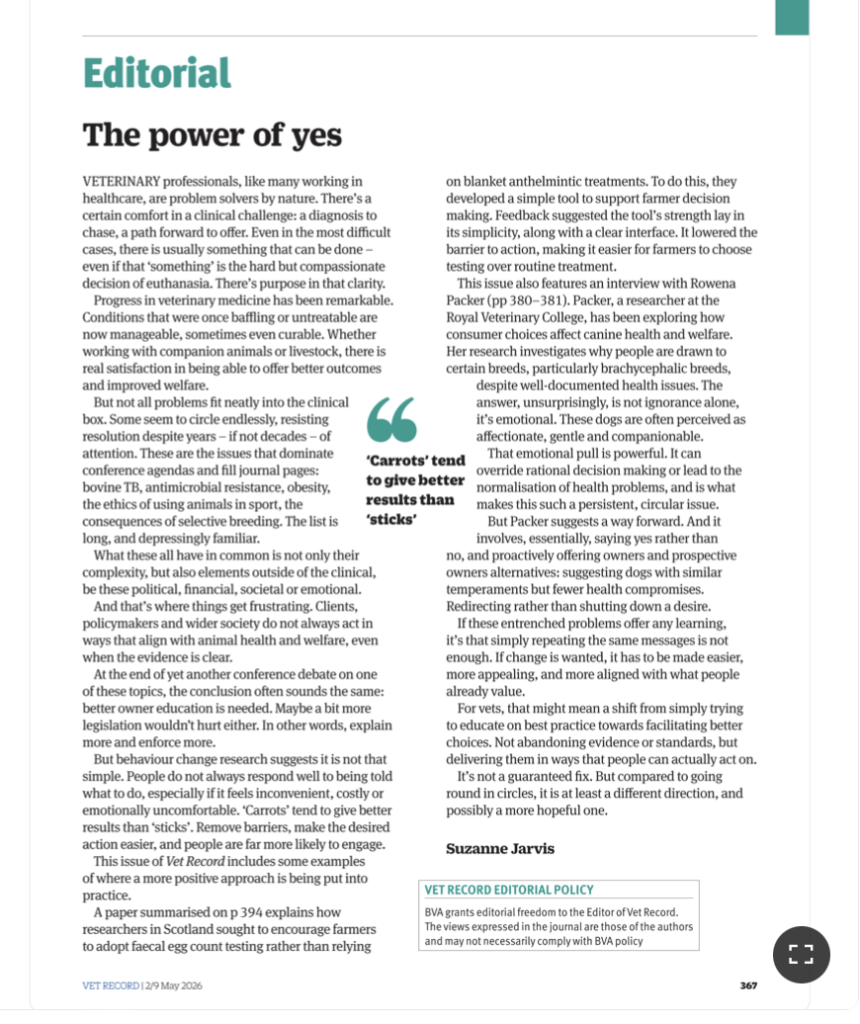
A recent editorial in Vet Record by Suzanne Jarvis quietly lands a point the dog world urgently needs to hear.
It should not be controversial. But it is.
Because it exposes why so many well-intentioned policies, campaigns and “solutions” are failing dogs.
At its heart is a simple truth:
“Carrots tend to give better results than sticks.”
And yet, across the dog world, we are still reaching for the stick.
The uncomfortable reality
Veterinary researcher Rowena Packer, quoted in the piece, has been exploring why people continue to choose dogs linked to well-documented health issues.
The answer is not ignorance.
It is emotion.
As the editorial explains, people are drawn to certain types of dogs because they are perceived as:
“affectionate, gentle and companionable”
In other words, people are not making spreadsheet decisions. They are making heart decisions.
And that emotional pull is powerful enough to:
- override evidence
- normalise health problems
- and keep demand flowing
This is where the system breaks
For years, the response has been predictable:
- Tell people what not to buy
- Warn them about health risks
- Introduce stricter rules and visual assessments
- Assume behaviour will change
But as the editorial makes clear, it doesn’t work.
Because:
“People do not always respond well to being told what to do, especially if it feels inconvenient, costly or emotionally uncomfortable.”
Sound familiar?
The missing piece: a better “yes”
Here is the part that should stop policymakers in their tracks.
The solution is not more “no”.
It is a better “yes”.
The editorial points to a different approach:
“Proactively offering owners and prospective owners alternatives: suggesting dogs with similar temperaments but fewer health compromises.”
Not shutting people down.
Redirecting them.
Helping them succeed.
The Union has been saying this all along
This is exactly why the Union of Good Dog People exists.
You cannot fix dog welfare by:
- punishing good breeders
- confusing the public
- or introducing blunt, one-size-fits-all tools
You fix it by changing the marketplace.
By making it easier for people to:
- find ethical breeders
- understand provenance
- choose dogs that truly fit their lives
And crucially:
- feel good about those choices
Why this matters now
If we ignore this, the consequences are already visible:
- rising demand for poorly bred dogs
- overwhelmed rescues
- increasing euthanasia
- and a marketplace that rewards the worst actors
The system is not just failing.
It is driving the problem.
A different direction
The editorial concludes that repeating the same messages is not enough:
“If change is wanted, it has to be made easier, more appealing, and more aligned with what people already value.”
That is the shift.
Not abandoning standards.
Not lowering welfare.
But delivering them in a way people can actually act on.
The line policymakers need to hear
You don’t improve dog welfare by telling people no.
You improve it by making the right choice the easiest one to say yes to.
If we get that right, everything changes.
If we don’t, nothing will.


Leave a Reply