
A major new study from the University of Bristol has confirmed what many of us working in dogs have been seeing with our own eyes.
More dogs are entering the system.
More dogs are staying longer.
And more dogs are dying as a result.
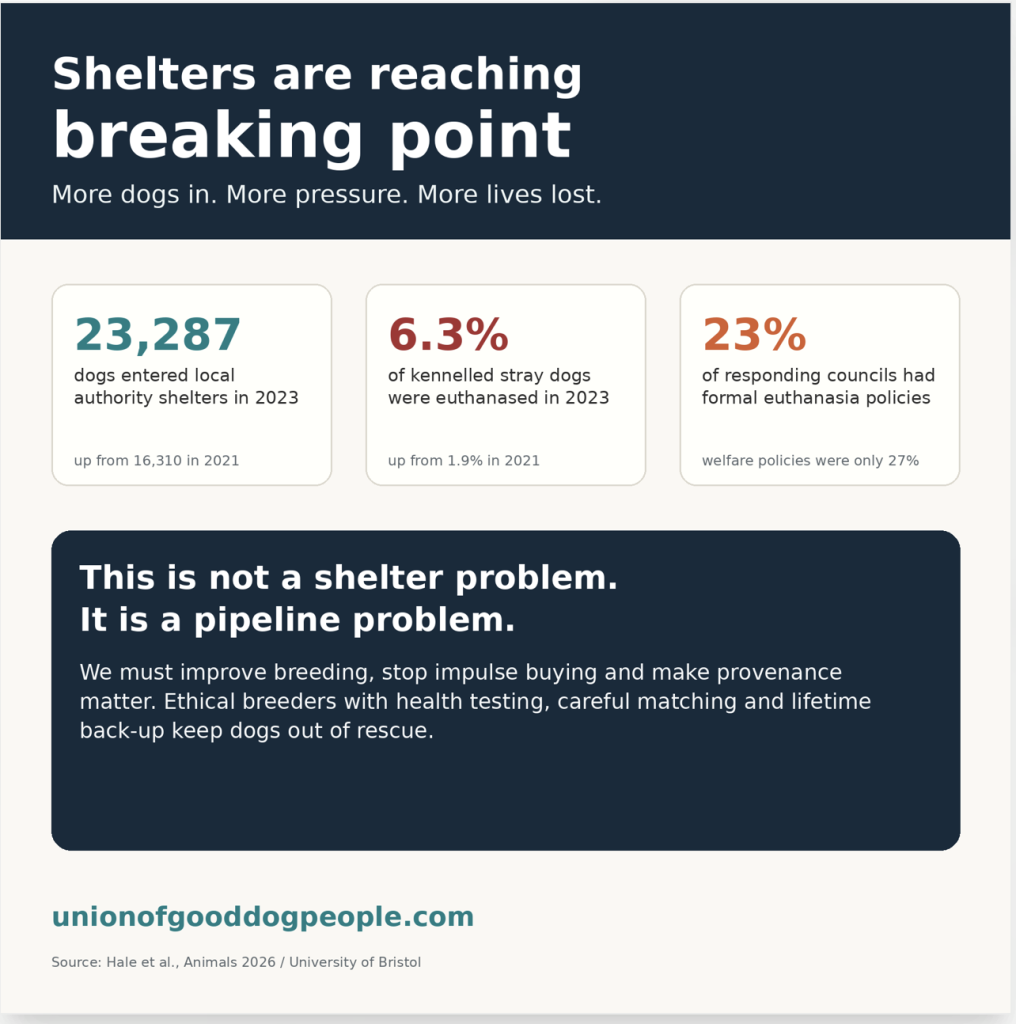
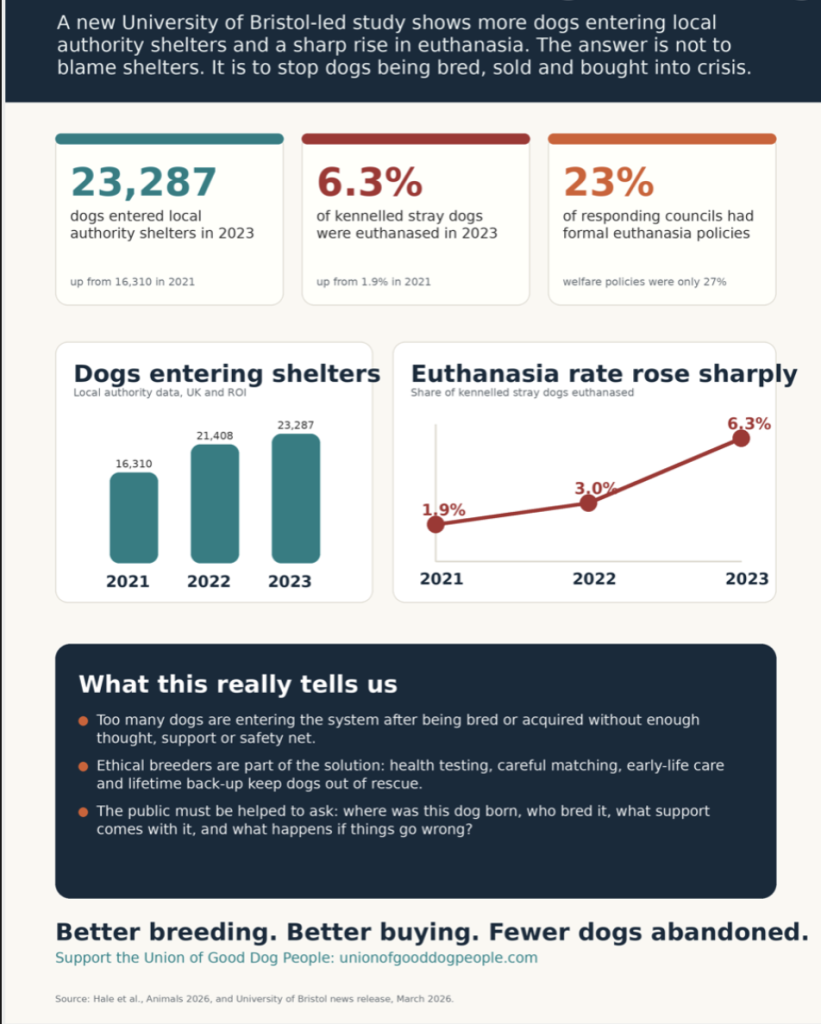
Between 2021 and 2023, the number of dogs entering local authority shelters rose from 16,310 to 23,287. At the same time, euthanasia rates more than tripled, rising from 1.9% to 6.3%.
That is not a blip. That is a trend.
But here is the part that should stop policymakers in their tracks.
Rehoming has actually improved.
More dogs are being successfully placed than before, rising from 41% to 53%.
So this is not a story about shelters failing.
It is a story about the system being overwhelmed.
This is not a rescue crisis. It is a breeding and sourcing crisis.
The study is clear about what is driving the pressure.
More dogs are coming in.
And the types of dogs coming in are changing.
Some of the dogs now entering the system cannot legally be rehomed at all.
XL Bullies, for example, are subject to legal restrictions that prevent rescues from placing them in new homes.
That leaves rescues holding dogs they cannot move on, adding further pressure to an already overloaded system.
These are not easy dogs to rehome quickly.
They stay longer.
They deteriorate in kennels.
And that increases their risk of euthanasia.
As one of the researchers put it, the rise in euthanasia is not because shelters have stopped caring. It is a symptom of a deeper crisis.
You cannot fix this at the back end
For too long, the national conversation has focused on rescue as the solution.
Build more kennels.
Fund more rescues.
Push more adoption campaigns.
But this study exposes the flaw in that thinking.
You cannot rehome your way out of a system that is being flooded.
Even when rehoming improves, euthanasia still rises if intake rises faster.
That is exactly what is happening now.
Dogs are arriving faster than they can be responsibly placed.
And once they are in the system, the clock is ticking.
The uncomfortable truth: where dogs come from matters
If we are serious about reducing suffering, we have to ask a more difficult question.
Where are these dogs coming from?
Because dogs do not appear in shelters by accident.
They are bred.
They are sold.
They are bought.
And too often they are:
- poorly matched to their owners
- poorly socialised
- bred without long-term responsibility
- sold without any safety net
When things go wrong, they end up in rescue.
And rescue is now at breaking point.
This is why the Union exists
The Union of Good Dog People was created for exactly this moment.
Because the only way to reduce suffering is to act upstream.
Not just to pick up the pieces afterwards.
We need:
- Ethical breeders who take lifetime responsibility
- Better early life care and socialisation
- Proper matching between dog and owner
- Buyers who understand that provenance matters
Dogs should not be born into a system that cannot absorb them.
If nothing changes, this will get worse
The trajectory is clear.
More intake.
Longer stays.
More behavioural decline.
More euthanasia.
And once that cycle accelerates, it is very hard to reverse.
You cannot legislate your way out with blunt tools.
You cannot rescue your way out at scale.
You have to reduce the flow at source.
A line we must hold
This study should be a wake-up call.
Not an excuse for more simplistic policies.
Not a justification for punishing responsible breeders.
But a clear signal that:
If we do not improve how dogs are bred and how the public chooses their next dog, more dogs will enter the system, and more dogs will die.
That is the reality.
And it is why the Union will keep fighting for a seat at the table.

Leave a Reply